Article: From the Cheka to the SVR: A Collector's Guide to Soviet & Russian Intelligence Badges and Medals
From the Cheka to the SVR: A Collector's Guide to Soviet & Russian Intelligence Badges and Medals

Why awards from the world's most secretive services are among the most fascinating and most misunderstood pieces in Soviet and Russian militaria.
There's a particular thrill in holding an award once pinned to the chest of a man whose entire career depended on never being noticed. Most Soviet medals tell a story you can read straight off the obverse. Intelligence pieces are different. They're the quiet end of the hobby, objects tied to operations that stayed classified for decades, to names that appeared on no public honor roll, and to a service that changed its initials half a dozen times while never once changing its purpose.
After years of handling these pieces, I've come to see Soviet and Russian foreign intelligence as a single thread running through the whole century of collectible militaria. With most awards, the value lives in the metal, the enamel, and the serial number. With an intelligence badge, the value lives in the institution behind it and that institution has one of the most remarkable lineages in the world. Understand the thread, and a whole category of collecting opens up.
One service, many names: the lineage every collector should memorize
The single most useful thing you can learn before buying in this field is the chain of organizational names. It explains the markings, the dates, and the anniversary medals you'll meet on the market and it instantly separates collectors who know the field from those who don't.
The story begins on 20 December 1917, when the new Soviet government created the All-Russian Extraordinary Commission, the VChK, or Cheka under Felix Dzerzhinsky. "Iron Felix" remains the founding face of Soviet state security, and his profile reappears again and again on later commemorative pieces; even KGB anniversary medals carry his portrait.
Foreign intelligence as a distinct discipline arrived slightly later. It grew up inside the Cheka's Special Department during the Civil War, and a dedicated Foreign Department, the INO, took shape within that structure around 1920. The date most collectors treat as the true birthday of the service is 20 December 1920, when Dzerzhinsky issued Order No. 169 establishing the INO as an independent intelligence arm. Modern Russian foreign intelligence still counts its history from that order.
From there the initials change, but the bloodline doesn't:
- VChK / Cheka (1917) — the origin, under Dzerzhinsky
- GPU (1922), then OGPU (1923) — the INO moves under each in turn as the USSR forms
- NKVD (1934–46) — the era of the great prewar and wartime networks
- NKGB / MGB / MVD (1940s–50s) — wartime and postwar reshuffles
- KGB (1954–1991) — its foreign intelligence arm was the famous First Chief Directorate (PGU)
- SVR — the Foreign Intelligence Service of the Russian Federation, the legal successor since 1992
The 1920s: the first generation and the Order of the Red Banner
The earliest officers were revolutionaries and underground operatives, people who believed completely in the new order. Within a few years the INO had built "legal" residencies in neighboring states and in the major capitalist powers of Europe: Britain, France, and Germany, while laying the groundwork for illegal intelligence and an agent network reaching into émigré circles and foreign government institutions.
One defining early triumph belonged to the counter-intelligence side of the service: "Syndicate-2," the elaborate deception operation that lured the émigré leader Boris Savinkov back across the border in August 1924 and rolled up his anti-Soviet underground. Run by the Counter-Intelligence Division of the OGPU under Artur Artuzov, it became part of the institutional memory the foreign service would later claim as its own. For collectors, what matters is what it produced in the cabinet: officers including A. P. Fedorov, G. S. Syroyezhkin and S. V. Puzitsky were among the first recipients of the newly unified all-Union Order of the Red Banner, established by decree in August 1924. Until the Order of Lenin appeared in 1930, the Red Banner was the highest decoration in the Soviet system, and any example from this early period carries real historical weight. Pieces with a documented tie to security or intelligence work from this decade are genuinely rare.
The 1930s and Spain: ideology as the recruiter
By the mid-1930s, with fascism rising across Europe, the service was recruiting not through coercion but through conviction. Sympathetic men and women in high places, the milieu that produced the celebrated "Cambridge Five" and the networks known as the "Red Orchestra" cooperated on ideological grounds. It's one of the great human stories of twentieth-century espionage, and it sits directly behind many of the awards collectors prize.
The Spanish Civil War sharpened everything. Soviet intelligence systematically tracked German and Italian support for Franco and ran officers into Spain as instructors and as leaders of reconnaissance-diversionary groups. Several figures who would become central to Soviet intelligence served there, among them Yakov Serebryansky and Naum (Leonid) Eitingon, who led the NKVD residency, alongside officers such as N. A. Prokopyuk, A. M. Rabtsevich, and Stanislav Vaupshasov who later became Heroes of the Soviet Union. For their Spanish service a group of NKVD officers was decorated by Soviet decree in late 1937, with awards including the Order of Lenin, the Order of the Red Banner, and the Order of the Red Star. These are names that reward research; several went on to careers that fill entire books.
The collecting takeaway: the Order of Lenin, Order of the Red Banner, and Order of the Red Star are the three decorations you'll most often meet at the intersection of intelligence history and the open market. The Red Star in particular is common enough to be an accessible entry point, yet an example with a documented operational background is anything but ordinary.
The Great Patriotic War: the field at its sharpest
During the war the service's entire effort bent toward Germany and its allies. Intelligence reporting fed directly into Soviet operational planning, warnings of the German drive toward the Caucasus, of the thrust through Rostov toward Stalingrad, of the build-up around the Kursk salient, plus steady reporting on Japan's intentions and Allied plans for a second front.
A number of career intelligence and special-operations officers received the title Hero of the Soviet Union for their wartime service, and many more earned combat orders. For collectors this is the richest documented period in the field. It's also where the "Distinguished NKVD Employee" badge, the highest NKVD departmental award of the war years belongs. A genuine numbered example with its original screw plate is a centerpiece, and one to buy only with full confidence in the source.
The Cold War and the KGB era
The defeat of Germany and Japan didn't simplify the world; it ushered in the Cold War, and foreign intelligence took on new priorities, strategic and scientific-technical collection, the atomic question, and the monitoring of Western alliances. Soviet and Russian accounts credit the service with a role in the atomic project, in the 1956 Suez crisis, and in the Cuban Missile Crisis.
For collectors, the KGB era produced some of the most desirable intelligence memorabilia in existence, precisely because so little of it was made for the public. KGB badges, table medals, academy pieces, departmental awards, and presentation items were issued internally to personnel, to veterans, or in small anniversary runs. Scarcity is baked into how they were made.
The modern SVR: the most overlooked corner of the hobby
When the USSR dissolved in 1991, the Soviet chapter closed and the SVR took over the foreign-intelligence mission under a 1992 law, operating today in a defined legal framework focused on identifying external threats and shaping conditions favorable to Russian policy abroad. Modern SVR insignia often preserves older intelligence symbolism swords, shields, stars, globes, while adopting the double-headed eagle and the Russian tricolor.
This late-Soviet and modern material is, in my view, one of the most overlooked corners of the field. These pieces were never made for the public... produced in limited numbers, issued internally, and rarely reaching the open market. Whether the wider market eventually catches up is anyone's guess, but for the collector who values rarity and craftsmanship over name recognition, it's some of the most rewarding ground in the hobby.
How to authenticate and buy without getting burned
A few hard-won principles:
- Anchor every piece to the timeline. If the markings, mint, and style don't agree with the era the seller claims, walk away. The name-chain above is your first authentication tool, the FSB name dates only from 1995 and KGB only from 1954, though anniversary pieces often count their history all the way back to the 1917 Cheka or 1920 INO, so read the anniversary year and the agency name together.
- Read the construction. Genuine official issues show careful metalwork, proper hard enamel, correct maker and mint marks, though collectors should note that certain departmental and presentation awards were produced without markings, so the absence of a mark is not, by itself, evidence against authenticity. Original cases, numbering, and honest wear all support authenticity. A real issue simply feels different from a modern souvenir.
- Documents multiply value and confidence. An award certificate, a research extract, or a named group turns an anonymous medal into a piece of history. Because the work was secret, documented intelligence pieces are rare, so when provenance exists, recognize it as the exception it is, and value it accordingly.
- Buy the seller first. In a field this specialized, with this much reproduction risk, who you buy from matters more than almost anything else.
Building your collection
If this thread of history pulls at you the way it pulls at me, the good news is that you can start almost anywhere along it, from an accessible Red Star or a late-Soviet anniversary medal up to the rarest prewar awards.
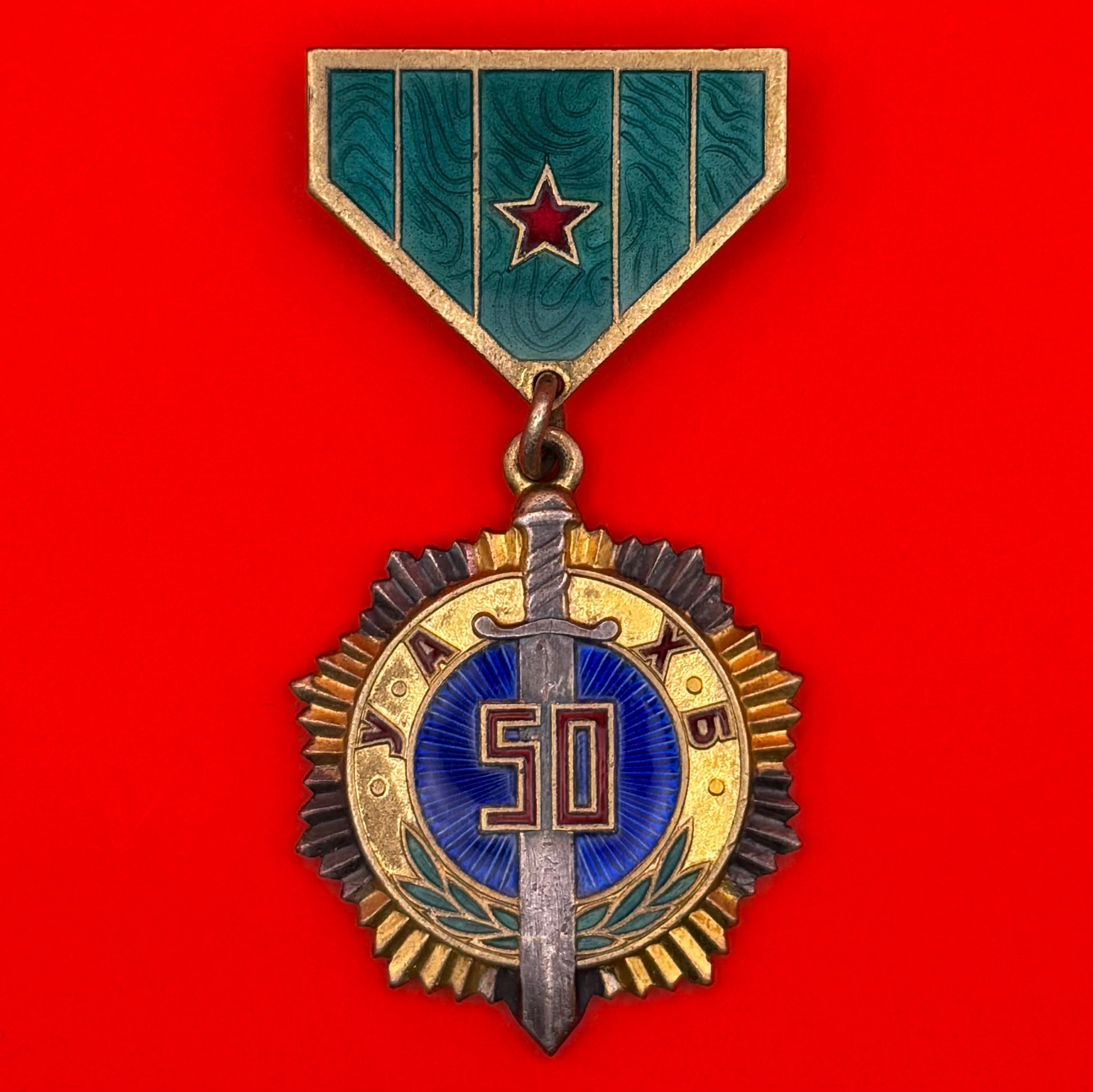
At KhanMilitaria, our Spy & Intelligence Memorabilia collection gathers authentic Soviet, Mongolian, and Eastern Bloc state-security pieces, SVR foreign-intelligence badges, KGB and NKVD items and rare Mongolian state-security awards, each selected for authenticity, historical relevance, and lasting collector value, and shipped worldwide with the care this material deserves.
Browse the current selection, and if you're hunting for something specific from this remarkable century of secret service, reach out, pieces like these rarely stay on the open market for long.
Like all militaria, these pieces are studied and preserved as historical record — fragments of a century that shaped the modern world. KhanMilitaria specializes in authentic badges, medals, and collectibles from Mongolia, the Soviet Union, the Eastern Bloc, and across Eurasia, offered strictly for historical, educational, and collecting purposes. Their inclusion does not represent an endorsement of any government, agency, organization, or ideology, past or present.